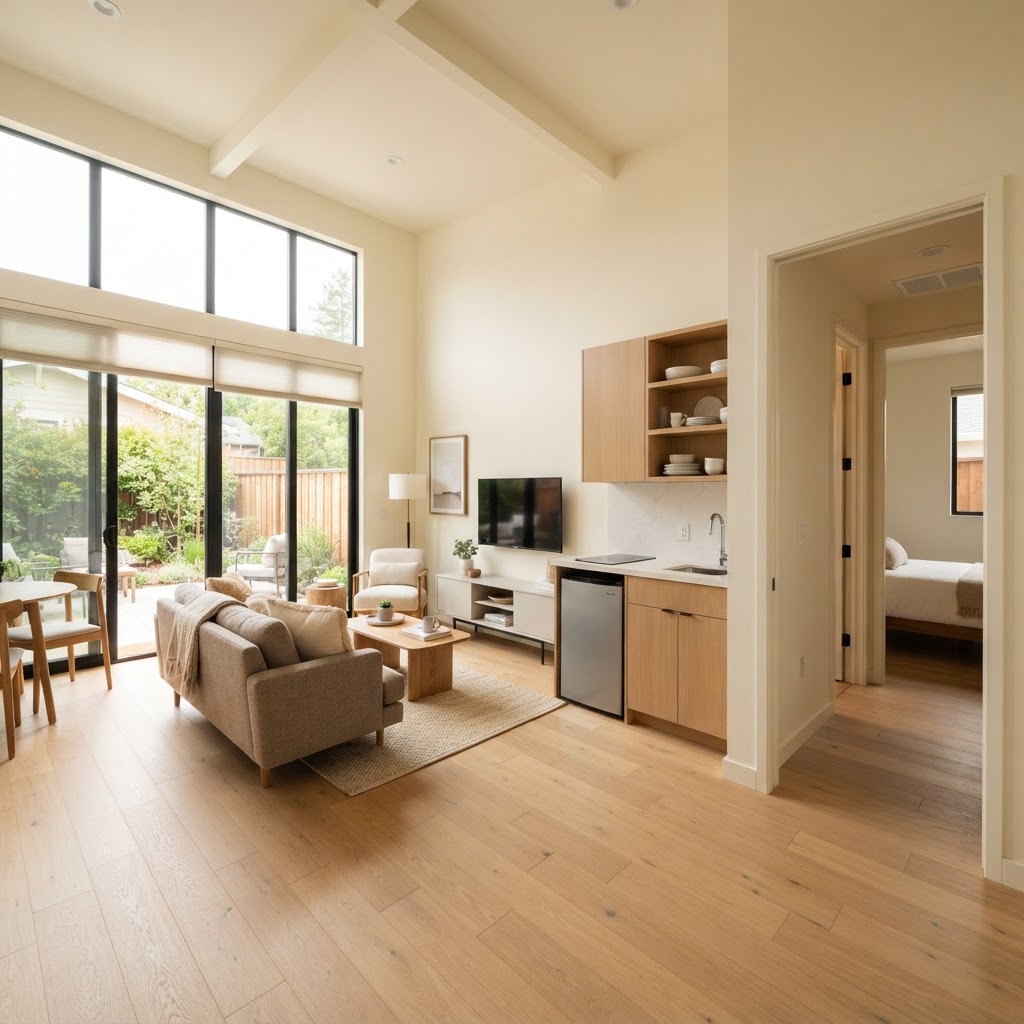
More Independence. Support Close By.
Accessibility and smart safety options for your backyard home. Whether you are planning a home for an aging parent or an adult son or daughter with a disability, the details matter.
BLS offers accessibility features and optional smart technology to help make everyday living more manageable while keeping family and caregivers connected when support is needed.
Thoughtful Design for Everyday Living
Getting through the front door, using the bathroom, and preparing a meal should all be considered when planning a home. Explore features that can be incorporated into your selected BLS layout based on the resident's needs.
Entrance Ramp
A ramp to the front door provides an alternative to steps. The entrance layout is planned around the selected home and property.
Wider Interior Doorways
Wider doorways provide additional room for moving between spaces with a wheelchair, walker, or other mobility aid. Final openings are confirmed for the selected layout.
Shower Grab Bars
Strategically positioned grab bars provide handholds for support while using the shower. Placement is considered as part of the bathroom design.
Toilet Grab Bars
Grab bars beside the toilet provide support for sitting, standing, and transfers, with placement planned around the bathroom layout and resident's needs.
GE Accessible Appliance Options
Select GE ADA-compliant appliances offer accessibility features such as easier-to-reach controls. Available features depend on the appliance model; for example, GE's ADA ranges have controls that do not require reaching across burners.
GE AppliancesKitchen Pot Filler
A faucet at the cooking area allows a pot to be filled where it will be used. Placement is reviewed around the resident's reach and kitchen layout.
The pot filler is presented as a kitchen convenience option rather than an automatic ADA or safety feature — its usefulness depends on the particular person and installation. Inclusion labels above are a starting point and should be confirmed against your actual BLS model specifications.
Smart Technology That Supports Independent Living
Optional SimplyHome technology can support everyday routines and notify designated caregivers when an event may need attention. The goal is to support independence and individual choice — not to add unnecessary supervision.
Know When the Stove May Need Attention
Stove SensorMonitors electric and induction stove use and alerts caregivers when the stove is left on too long or unattended.
Stay Aware of Doors Opening and Closing
Door / Window SensorDetects when a door or window opens or closes, helping caregivers stay informed about arrivals, departures, and nighttime activity.
Get Notified About Overnight Bed or Chair Exits
Chair / Bed Pressure Pad SensorDetects when someone gets up from a bed or chair during overnight hours and alerts the designated support team.
Receive Water-Leak and Smoke-Alarm Notifications
Flood Sensor & Smoke Alarm MonitorA flood sensor detects water on the floor. A separate smoke alarm monitor listens for an existing smoke alarm and notifies caregivers.
Request Help With the Press of a Button
Button SensorProvides a one-press way to send an alert to caregivers, on-site staff, or an arranged remote-support team.
Support Medication Routines
Medication DispenserProvides access to prescribed medication and can notify caregivers of missed doses by text, email, or phone.
Detection, notification, and response are separate things. Alerts go to recipients you arrange — caregivers, on-site staff, or a remote-support team — and do not automatically produce emergency assistance. The stove sensor alerts rather than shutting the stove off, and the smoke alarm monitor listens to an existing alarm rather than replacing a smoke detector. Confirm recipients, response services, connectivity, fees, and consent/privacy handling with SimplyHome before publishing.
Camera-Free Fall and Wellness Monitoring
Silver Shield by Pontosense
Silver Shield uses a contactless sensor to detect events such as falls, bed exits, and room exits, while also providing information about activity and daily routines — without cameras, microphones, or a wearable device.
Safety alerts, activity insights, and weekly wellness reports can help caregivers recognize changes that may need attention.
Safety Alerts
Real-time notifications for events such as falls, bed exits, and room exits.
Activity & Routine Insights
Understand daily activity patterns and recognize changes that may need attention.
Weekly Wellness Reports
Summarized reports help caregivers track wellness trends over time.
Silver Shield is not a medical device and is not intended for critical or emergency medical care. The “no cameras, microphones, or wearables” statement applies to Silver Shield specifically — the broader technology offering includes a video doorbell and a wearable watch.
Options Inside a BLS Home
A look at how home-design features and optional technology can come together in one layout. Two marker styles separate what's part of the home from what's added technology. Locations are illustrative — your designer and technology provider confirm placement for your plan.
Home Design Features
- 1. Entrance ramp
- 2. Wider interior doorways
- 3. Bathroom grab bars
- 4. Accessible appliances
- 5. Kitchen pot filler
Optional Technology
- 6. Door / window sensor
- 7. Flood sensor
- 8. Stove sensor
- 9. Bed-exit sensor
Let's Plan Around the Person Who Will Live Here
Not every resident needs every feature. Some families are focused on easier entry and bathroom access. Others want help with cooking routines, nighttime activity, or staying connected when support is needed. Tell us what matters most — we'll explain what's included, what's optional, and what requires additional planning.